GetYourGuide5 hours
Nature· Whole island
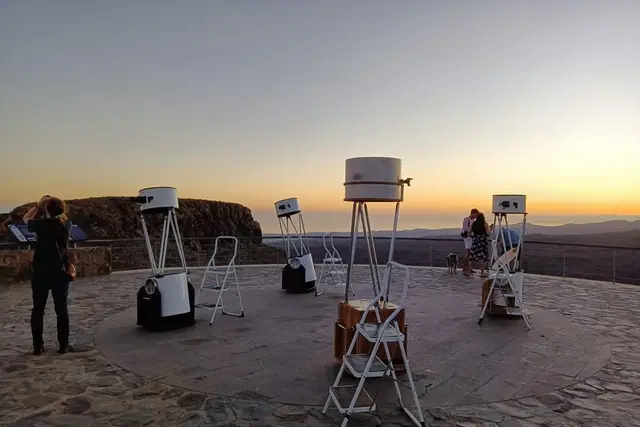
Gran Canaria: Stargazing Tour with Big Telescopes & Pick-up
4.9 (16)
from €85Check availability
Summit and natureNature · night sky
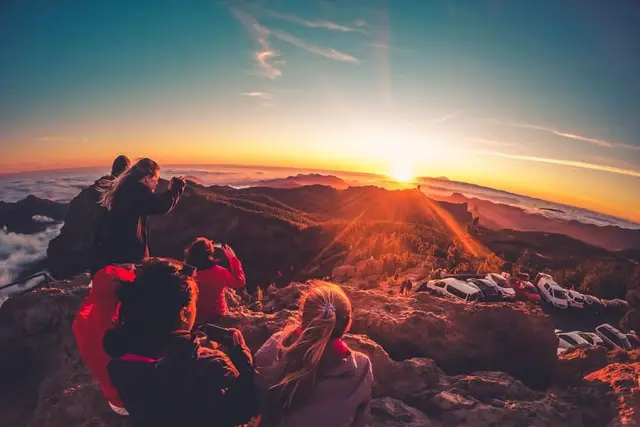
For stargazing in Gran Canaria, head up to the summit, above the clouds, on a moonless night with a proper jacket. The two specialists are separate companies: AstroGC collects you from your hotel; AstroEduca is cheaper if you drive.
63 min 57 km · by car, no traffic
Updated 15 October 2026Facts checked against official sourcesContains affiliate links
3 options · Prices checked on 15 October 2026
Nothing matches that combination. Remove a filter.
GetYourGuide5 hours
Nature· Whole island
4.9 (16)
from €85Check availability
GetYourGuide3 hours
Nature· Whole island
4.9 (38)
from €52Check availability
GetYourGuide2 hours
Nature· Whole island
5.0 (9)
from €59Check availability
Stargazing in Gran Canaria works for a simple reason: the trade-wind cloud layer, known locally as panza de burro ("donkey's belly"), sits below the summits and blocks much of the light from the coastal towns. Up in the middle of the island the sky is dark and steady. You don't need to go to another island or book anything to see the Milky Way in summer; you do need a car, a moonless night and something warm.
Gran Canaria has been on the Starlight Foundation's list as a Starlight Tourist Destination since December 2017. It is not a "Starlight Reserve": that is a different category, held in the Canary Islands by La Palma, Fuerteventura and the summits of Tenerife. The municipality of Santa Lucía de Tirajana also has its own Starlight Destination certificate since November 2022.
The heart of the destination is the Tejeda Basin, the great volcanic amphitheatre in the centre of the island, which matches the Biosphere Reserve. In Artenara the street lighting is shielded so you can observe from the village itself.
Official astronomy viewpoints. The Cabildo (island council) has signposted two for observing on your own:
La Aldea de San Nicolás has added three more: Paso del Marinero, La Sabinilla and Cruz del Siglo. Other sites have been studied for the future (Pico de las Nieves, Caldera de los Marteles, Presa de Hornos…), but we don't know whether they have been fitted out yet.
Llanos de la Pez (about 1,600 m, Nublo Rural Park) is where AstroEduca meets its groups. AstroGC, by contrast, chooses the spot each night according to cloud and wind, usually in the western mountains, with a stop at the Mirador del Mulato viewpoint.
Observatories and centres. The Guguy visitor centre in Tasartico was the first observatory in the Starlight area. San Mateo has the Roque Saucillo Astronomy Centre, aimed at school visits, and the CARS urban observatory, run by AstroEduca on the top floor of the municipal music school. We have not been able to confirm visits to the Temisas observatory (Agüimes).
They are two separate companies with opposite approaches.
AstroGC (Maspalomas, since 2012) is the easy option from the south:
AstroEduca (since 1995, Canarian astronomers and teachers with Starlight certification) is the cheap option if you have a car:
| Item | AstroEduca (on your own) | AstroGC (with pick-up) |
|---|---|---|
| Price for a couple | €80 | €120 |
| Family of 4 with two 8-year-olds | €110 | €220 |
| Transport | your car up to the summit | minibus from your hotel |
| Duration | about 2 h | about 5 h |
| If it clouds over | the company cancels and refunds or rebooks | you don't pay |
| Sunset | not included | included on the way |
Our view: if you are staying in Maspalomas, Playa del Inglés or Puerto Rico and don't want to drive mountain roads at night, AstroGC is worth the difference; paying only for a clear sky takes away the risk. If you have a car and want to save money, AstroEduca. We compare both in our AstroGC and AstroEduca review.
The platform has four well-rated options:
On GetYourGuide many listings let you reserve now and pay later; cancellation terms vary from one to the next, so check them before you pay.
GetYourGuide3 - 6 hours
Nature· Whole island
4.9 (315)
from €45Check availability
GetYourGuide5 hours
Nature· Whole island
4.9 (16)
from €85Check availability
GetYourGuide3 hours
Nature· Whole island
4.9 (38)
from €52Check availability
GetYourGuide2 hours
Nature· Whole island
5.0 (9)
from €59Check availability
See everything on GetYourGuide →Prices checked on 15 October 2026
The moon matters more than the season. Under a full moon the sky brightens and you lose galaxies and faint nebulae. The darkest nights are the week before and the week after the new moon. Check the moon calendar before you book: any astronomy app shows the phase for that night.
The Milky Way. Its core is visible from April to October, best from May to August. AstroEduca runs dedicated sessions for photographing it at that time of year.
Winter. The nights are long and observing starts early: AstroEduca meets at 19:30. It is the cloudiest season, with the odd weather front, so leave yourself several nights' leeway.
| Jan | Feb | Mar | Apr | May | Jun | Jul | Aug | Sep | Oct | Nov | Dec | |
|---|---|---|---|---|---|---|---|---|---|---|---|---|
| Milky Way | 0 | 0 | 0 | Poor | Good | Best | Best | Best | Good | Poor | 0 | 0 |
| Long nights | Best | Best | Good | Poor | Poor | 0 | 0 | 0 | Poor | Good | Best | Best |
| Steady sky | Good | Good | Good | Best | Best | Best | Best | Best | Best | Good | Good | Good |
PoorGoodBest
This is the most common mistake. You leave Maspalomas in shorts and at 22:00 you are standing still above 1,600 m in the wind. AstroEduca makes it a rule: warm clothing is compulsory, even in summer. Bring:
| Month | Sunrise | Sunset | Daylight |
|---|---|---|---|
| January | 07:55 | 18:29 | 10 h 34 min |
| February | 07:40 | 18:53 | 11 h 13 min |
| March | 07:12 | 19:11 | 11 h 58 min |
| April | 07:38 | 20:27 | 12 h 49 min |
| May | 07:13 | 20:45 | 13 h 32 min |
| June | 07:06 | 21:00 | 13 h 54 min |
| July | 07:16 | 21:01 | 13 h 45 min |
| August | 07:32 | 20:41 | 13 h 09 min |
| September | 07:47 | 20:08 | 12 h 20 min |
| October | 08:02 | 19:34 | 11 h 31 min |
| November | 07:24 | 18:10 | 10 h 47 min |
| December | 07:46 | 18:09 | 10 h 23 min |
Canary time in mid-month, calculated for the centre of the island.
Without a tour, the only way is by car: there are no guaguas (buses) to the summit at that hour. From Maspalomas, the Fataga road takes you to the Degollada de las Yeguas; for Llanos de la Pez and the Roque Nublo area allow considerably longer. These are narrow, winding mountain roads: drive slowly, dip your lights for oncoming traffic, and don't park on bends.
| Playa del Inglés | Maspalomas / Meloneras | Puerto Rico / Amadores | Puerto de Mogán | Las Palmas | |
|---|---|---|---|---|---|
| Llanos de la Pez | 65 min42 km | 70 min65 km | 85 min75 km | 85 min82 km | 55 min40 km |
| Fataga | 28 min18 km | 34 min21 km | 51 min34 km | 51 min41 km | 67 min71 km |
| Artenara | 120 min63 km | 126 min66 km | 141 min95 km | 126 min58 km | 90 min53 km |
| Pico de las Nieves | 63 min57 km | 67 min62 km | 82 min73 km | 82 min79 km | 52 min47 km |
Free-flow driving time calculated with OSRM on OpenStreetMap. In summer and at rush hour allow 20–30 % more, plus time to park.
For a full day-and-night plan, combine Roque Nublo in the afternoon (no booking needed after 17:00), sunset on the summit and then the stars. More ideas for the evening in couples and nightlife, and if you are travelling with children, AstroGC takes them from age 3: see Gran Canaria with children.
On the summit: the astronomy viewpoints at Las Cañaditas (Artenara) and the Degollada de las Yeguas on the Fataga road, or the Llanos de la Pez area. Away from the coastal lights and above the clouds.
No. It has been a Starlight Tourist Destination since December 2017. The Starlight Reserve category belongs to other areas, such as La Palma or the summits of Tenerife.
AstroGC charges €65 for the first person and €55 for each extra, with pick-up in the south, and only if the sky is clear. AstroEduca charges €40 per adult in your own car. On GetYourGuide there are tours from €45.
With AstroGC you don't pay: you pay at the end and only if the observation went ahead. AstroEduca refunds or offers another date if the company cancels because of the weather.
Yes, even in summer. Sessions are above 1,600 m, at night and often in the wind: bring a proper coat, long trousers and closed shoes.
Any month around the new moon. For the Milky Way, May to August; in winter it gets dark earlier but there are more cloudy nights.
Booking calendars The GetYourGuide and Tiqets calendars are loaded by those companies and may use cookies. This site uses no cookies or analytics of its own. More information