GetYourGuide2.5 hours
Sea· Whole island
Gran Canaria: Dolphin and Whale-Watching Cruise
4.2 (3,236)
from €38Check availability
Sea and boatsSea · whale and dolphin watching
Dolphin watching in Gran Canaria mostly starts from Puerto Rico, Puerto de Mogán and Pasito Blanco: from €35 on a big boat to €85 in a group of ten with a marine biologist. Bottlenose and spotted dolphins almost always; whales only sometimes.
22 min 20 km · by car, no traffic
Updated 15 October 2026Facts checked against official sourcesContains affiliate links
9 options · Prices checked on 15 October 2026
Nothing matches that combination. Remove a filter.
GetYourGuide2.5 hours
Sea· Whole island
4.2 (3,236)
from €38Check availability
GetYourGuide2.5 hours
Sea· Puerto Rico and Mogán
4.3 (2,728)
from €40Check availability
GetYourGuide3 hours
Sea· Puerto Rico and Mogán
4.5 (49)
from €85Check availability
GetYourGuide4 hours
Sea· Puerto Rico and Mogán
4.7 (282)
from €89Check availability
GetYourGuide
Sea· Maspalomas and Playa del Inglés
4.7 (1,843)
from €39Check availability
Tiqets
Towns and trips· Puerto Rico and Mogán
4.8 (5)
from €80Check availability
GetYourGuide2 hours
Sea· Whole island
4.4 (622)
from €36Check availability
GetYourGuide2 hours
Sea· Puerto Rico and Mogán
4.0 (317)
from €30Check availability
Dolphin watching in Gran Canaria is one of the easiest trips on the south coast: you leave the harbour in the morning or early afternoon, and more often than not a pod of dolphins turns up. What varies a lot from boat to boat is the size of the group, how long you spend with the animals, whether there is a swim stop and whether you get anything more than a soft drink.
Below: which species you will really see, what the "guarantees" amount to, why no legal boat lets you swim with dolphins, and which kind of boat suits you. If what you want is a day on the water with food and drink, look at the guides to catamarans and boat trips too.
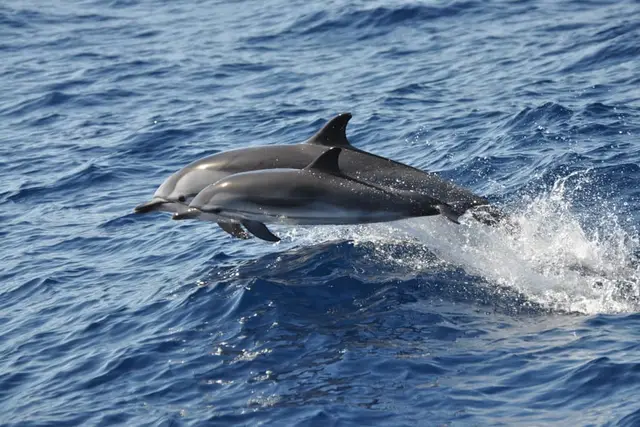
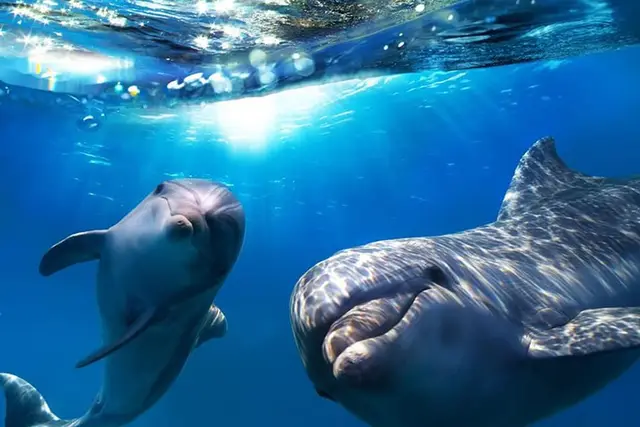
Every company on the island names the same two species as the regulars: the bottlenose dolphin (the big grey "film dolphin") and the Atlantic spotted dolphin, known in the Canaries as tonina. The short-finned pilot whale, a large dark dolphin that lives in family groups, also turns up regularly.
Depending on the day, the boats also report common dolphins, striped dolphins, Risso's dolphins, rough-toothed dolphins, false killer whales and beaked whales (deep-diving whales with a pointed snout). The big whales, such as humpbacks or sperm whales, are occasional: WeWhale puts it plainly, "sometimes". Around 26 species of cetacean have been recorded in Canary waters, but that does not mean you will see more than one or two on a single trip.
In Spain, whale and dolphin watching is regulated by Royal Decree 1727/2007. There is a 500 m protection circle around the animals, and inside it:
The Canaries add their own Decree 178/2000, which penalises chasing or encircling the animals, feeding them, staying more than 30 minutes within 100 m, or approaching on a jet ski closer than 500 m. You can read the text in the Boletín Oficial de Canarias and the royal decree in the BOE.
Boats licensed for this activity fly a blue flag reading "Barco Azul". It is the permit, not an eco award: if your boat does not fly it, get off.
You cannot swim with wild dolphins in Gran Canaria, and no legal trip offers it. The Canarian decree bans swimming or diving within 500 m of cetaceans, and national law bans touching or feeding them.
So what are the products with names like "Dolphin Safari and a swim" or "dolphin-watching cruise with swim stop"? They are an ordinary watching trip plus a swim stop in a cove, well away from the animals. It is the same model as Spirit of the Sea's 13:30 sailing, which is its trip with a swim (the 10:30 one does not stop), sea conditions permitting.
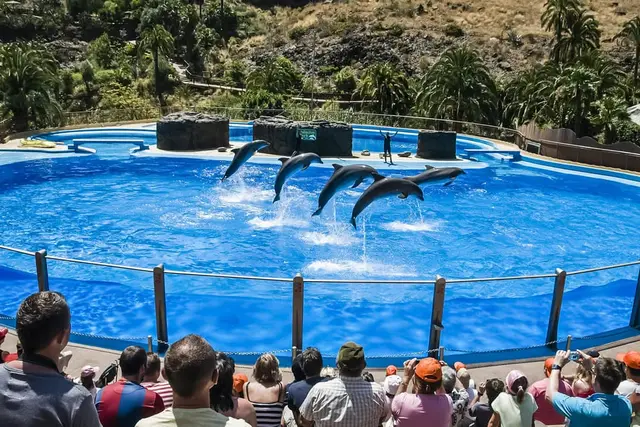
If you really want to be in the water with dolphins, the only option on the island is the "Dolphin Encounter" at Palmitos Park, with bottlenose dolphins that live in the park. It lasts more than 30 minutes, takes no more than 16 people per session, is paid separately and cannot be booked online: you sign up inside the park on the day. The park advises going to the booking point at around 10:00. The price and minimum age are not published. The dolphin shows, included in the ticket (€35 online, €39 at the gate), are at 13:30 and 16:00. More at palmitospark.es.
There are three ways to do this trip, and the difference shows more than the price.
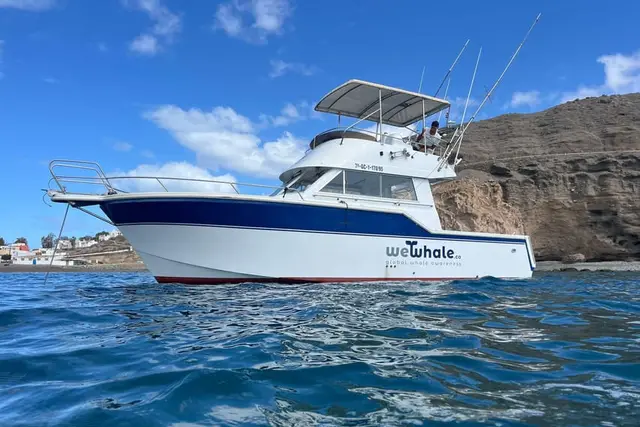
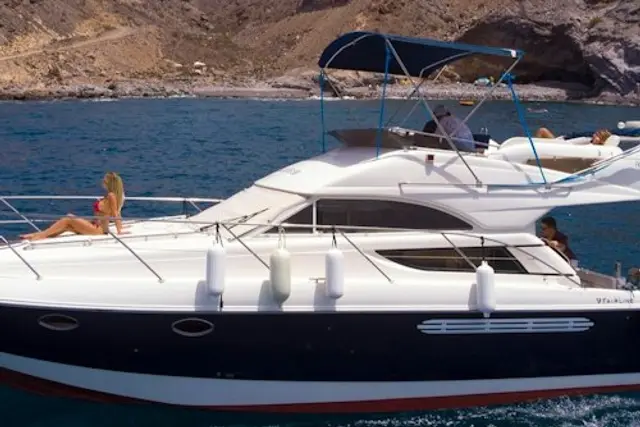
WeWhale sails from Pasito Blanco (Ribera pontoon), a quiet marina about 2 km from Maspalomas. Its boat, the Senda del Azul, is a Rodman 1100 converted to hybrid with two electric motors; it carries a hydrophone to listen to the animals and a 360° underwater camera, and has a biologist on board. The shared group is 8 to 10 people (the website itself gives both figures).
It costs from €85 per adult, €70 per child and €35 per infant, about 2.4 times the Líneas Salmón fare. In return: fewer people at the rail, a quiet motor near the animals and someone who explains what you are looking at. There is no swim stop and no sighting guarantee; they talk of "frequent encounters with dolphins". The trip lasts about 3 hours, with morning (09:30) and afternoon (14:00) departures; in October it was sailing Tuesday to Saturday. There is also a sunset trip from €75 and a private boat from €850. On GetYourGuide it appears as a small-group eco boat tour, from €85. Website: wewhale.co.
The classic option and the cheapest. Líneas Salmón runs a trip of about 2 hours for €35 per adult and €25 per child (6–12); under-6s go free and the bus from your hotel costs €4 extra. The big plus is that it picks up at four harbours, twice a day: Puerto de Mogán 09:45 / 12:45, Arguineguín 10:15 / 13:15, Anfi del Mar 10:30 / 13:30 and Puerto Rico 10:45 / 13:45. If you are staying in Mogán or Arguineguín, you leave from your own harbour. Times and booking at lineassalmon.es.
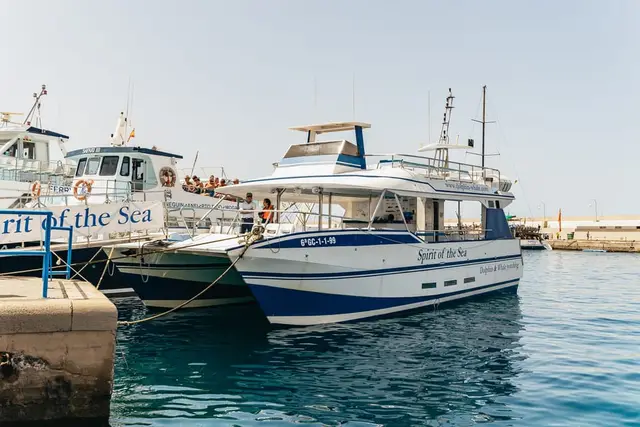
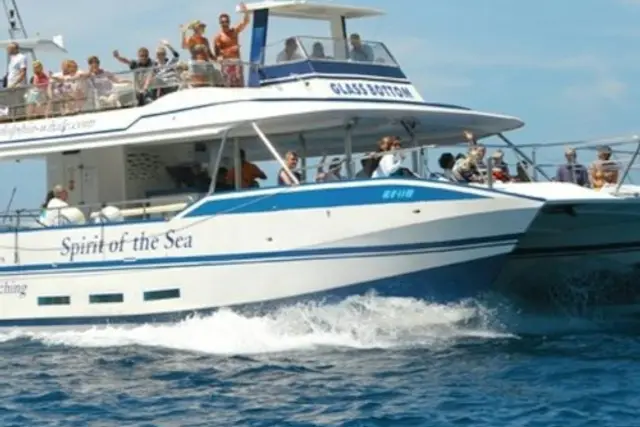
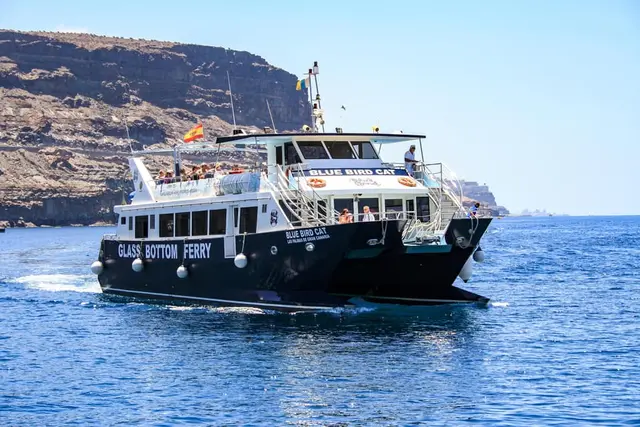
Spirit of the Sea is a catamaran with glazed hulls that sails from Puerto Base in Puerto Rico at 10:30 and 13:30, for about 2 h 30 (the 13:30 one with a swim). Through resellers it costs around €40 per adult and €25 per child, and it has a free transfer from Mogán–Playa del Cura and Bahía Feliz–Meloneras if you ask 24 hours ahead: spiritoftheseatours.com. Note: it is not the same company as Blue Bird, even though the two are often sold together.
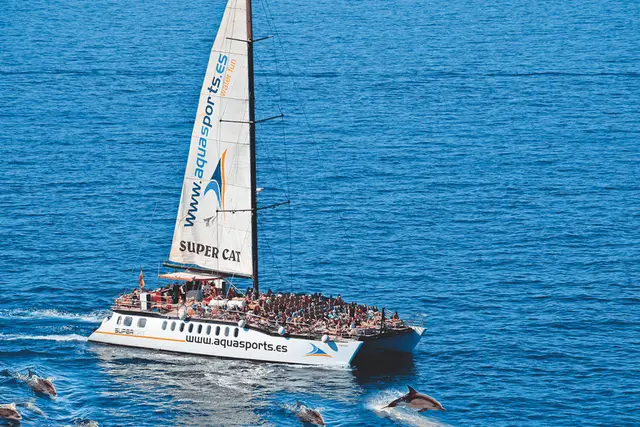
AquaSports sells the 2-hour Supercat trip from Puerto Base for €38 with one drink; you need to be on the quay 45 minutes before. The 4-hour version with lunch, open bar and a swim is really a full boat day out. There is no hotel pick-up if you are staying in Puerto Rico: you walk.
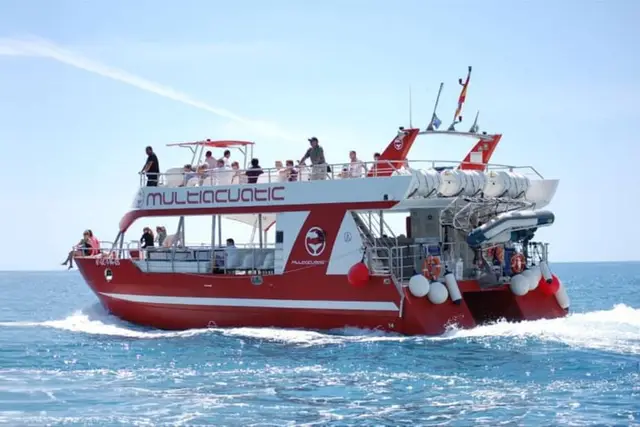
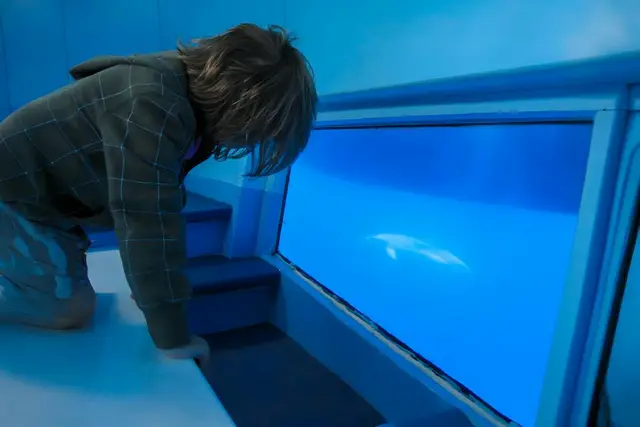
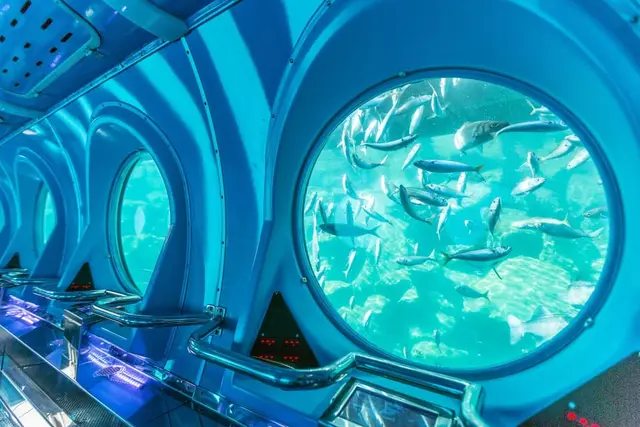
The Líneas Blue Bird boats, run by the coastal ferry company, all have windows or panels for looking under the water. The "glass-bottom" trips you will see on Headout and GetYourGuide are these. They keep children busy while waiting for the dolphins, but you see the dolphins themselves from the deck: the glass is an extra.
Pros
Cons
The same trips are sold on the boat company's website, at harbour kiosks and on platforms such as GetYourGuide, Tiqets and Headout. Here is the comparison for the glass-bottom dolphin-watching cruise:
| Platform | Product | Rating | Price | Where |
|---|---|---|---|---|
| GetYourGuide | Gran Canaria: Dolphin and Whale-Watching Cruise | 4.2 (3,236) | €38 | See on GetYourGuide |
| Headout | Gran Canaria: Dolphin & Whale Watching Cruise with Glass Bottom & Snorkeling | 4.5 (16) | €38 | See on Headout |
Adult price, checked on 15 October 2026. Platforms change prices daily: confirm before you pay.
Today GetYourGuide and Headout are level at €38. The difference is in the terms: GetYourGuide lets you "reserve now, pay later", and Headout does not say who runs the boat. If you are staying in Puerto Rico, Mogán or Arguineguín, booking directly with Líneas Salmón (€35) is the cheapest way to do a similar trip.
GetYourGuide3.5 hours
Sea· Puerto Rico and Mogán
4.4 (6,196)
from €38Check availability
Tiqets
Towns and trips· Puerto Rico and Mogán
4.8 (5)
from €80Check availability
GetYourGuide2 hours
Sea· Whole island
4.4 (622)
from €36Check availability
GetYourGuide2 hours
Sea· Puerto Rico and Mogán
4.0 (317)
from €30Check availability
GetYourGuide3 hours
Towns and trips· Whole island
4.4 (144)
from €36Check availability
Headout
Sea· Whole island
4.7 (3)
from €40Check availability
See everything on GetYourGuide →Prices checked on 15 October 2026
Which one to book
1
Families and first-timers
A 3.5-hour catamaran trip with dolphin watching and a snorkel stop, the dolphin product with the most reviews on the island.
GetYourGuide3.5 hours
Sea· Puerto Rico and Mogán
4.4 (6,196)
from €38Check availability
2
If you want a proper look at the animals
A group of about 10, electric motor and a biologist on board from Pasito Blanco.
GetYourGuide3 hours
Sea· Puerto Rico and Mogán
4.5 (49)
from €85Check availability
3
Couples in Mogán
Four hours, dolphin watching and a swim in a cove; rated 4.7.
GetYourGuide4 hours
Sea· Puerto Rico and Mogán
4.7 (282)
from €89Check availability
4
Tight budget
Two hours on a catamaran from Puerto Rico, from €30.
GetYourGuide2 hours
Sea· Puerto Rico and Mogán
4.0 (317)
from €30Check availability
Several companies promise you will see dolphins. This is what each one says:
| Boat | What it promises |
|---|---|
| Líneas Salmón | "Guaranteed sighting", with no conditions explained |
| Spirit of the Sea | Its website guarantees nothing; some resellers give a voucher to go again within a year |
| AquaSports (2 h catamaran) | Dolphins or whales, or a ticket to go again; it also admits they are "not always" seen |
| Magic 3 (Mogán) | A "90%" chance of seeing dolphins, turtles or flying fish |
| WeWhale | No guarantee; "frequent encounters" |
In practice, "guaranteed" means that if you are out of luck, they let you go again another day for free. They never refund your money. That is why it pays to do the trip early in your holiday: if it fails, you still have days left to use the voucher. Keep it safe.
| Playa del Inglés | Maspalomas / Meloneras | Puerto Rico / Amadores | Puerto de Mogán | Las Palmas | |
|---|---|---|---|---|---|
| Puerto Rico / Amadores | 22 min20 km | 20 min17 km | here | 20 min13 km | 60 min73 km |
| Pasito Blanco | 12 min9 km | 8 min4 km | 24 min15 km | 24 min22 km | 50 min62 km |
| Puerto de Mogán | 26 min26 km | 25 min23 km | 27 min15 km | here | 65 min79 km |
Free-flow driving time calculated with OSRM on OpenStreetMap. In summer and at rush hour allow 20–30 % more, plus time to park.
The south coast is sheltered from the trade wind, which blows harder in summer, but in winter Atlantic depressions can bring a swell. There is no proven "calmest month": check the forecast the day before.
How not to get sea-sick
With children, the big boat with a bar and toilet is the most comfortable; under-6s travel free with Líneas Salmón. Bring a cap, sun cream, a warm layer for the wind on deck and swimwear if your trip has a swim stop. For family plans, see the guide to Gran Canaria with kids. If you want more time in the water, snorkelling and the Mogán submarine go well with it.
Not with wild dolphins: Canarian law bans swimming within 500 m of them. Trips "with a swim" stop in a cove away from the animals. The only in-water encounter is at Palmitos Park, with the park's own dolphins, and you book it there on the day.
From €30 on platforms for 2 hours on a catamaran, €35 direct with Líneas Salmón (child €25) and from €85 on WeWhale's eco boat. The 4-hour versions with food and drink go up to €60–90.
Mainly from Puerto Rico (Puerto Base and Puerto Escala), Puerto de Mogán, Arguineguín, Anfi del Mar and Pasito Blanco. Líneas Salmón picks up at the first four.
Sometimes. The regulars are bottlenose dolphins, spotted dolphins and short-finned pilot whales; humpbacks and sperm whales turn up occasionally.
Spirit of the Sea stops only on the 13:30 sailing. Products sold as "safari and a swim" or "with swim stop", and the 4-hour catamarans, also include a stop in a cove.
Booking calendars The GetYourGuide and Tiqets calendars are loaded by those companies and may use cookies. This site uses no cookies or analytics of its own. More information